










If you’ve been shopping the mushroom gummy market and feeling confused about what exactly you’re looking at, you’re not alone. The language around these products is genuinely muddy — and that muddiness exists for a reason, since some brands benefit from the ambiguity.
Here’s a clear, honest breakdown of what “mushroom gummies” actually means, what psilocybin actually is, and why the distinction matters for your safety, your legal exposure, and the experience you’ll have.
First: What Is Psilocybin?
Psilocybin is a naturally occurring psychedelic compound found in certain species of mushrooms — commonly called “magic mushrooms” or “shrooms.” When consumed, psilocybin is metabolized into psilocin, which produces psychedelic effects by acting on serotonin receptors in the brain.
Psilocybin is classified as a Schedule I controlled substance under federal law in the United States. This means it is federally illegal to possess, sell, or distribute — with narrow exceptions for research. A small number of cities and states have decriminalized it or created regulated therapeutic access frameworks, but it remains federally prohibited.
Mushroom gummies that contain psilocybin are illegal to sell in the US under federal law. Any brand selling them through regular e-commerce channels is either operating illegally or not actually including psilocybin in their product (a common deception).
So What Are Legal Mushroom Gummies Made Of?
Legal, non-psychoactive mushroom gummies sold through legitimate retailers like Shroom Time use different active compounds entirely. There are two main categories:
1. Functional Mushroom Extracts
These are gummies made from culinary and medicinal mushroom species — lion’s mane, reishi, chaga, cordyceps, turkey tail, and others. These mushrooms contain no psilocybin and produce no psychedelic effects. Instead, they’re valued for adaptogenic, nootropic, and wellness properties:
- Lion’s mane — associated with cognitive support and nerve growth factor (NGF) stimulation
- Reishi — an adaptogen associated with stress modulation and immune support
- Cordyceps — associated with energy and athletic endurance
- Chaga — antioxidant-rich, associated with immune function
These are the functional wellness end of the mushroom gummy market. They’re legal everywhere, carry no psychedelic effect, and are taken more like a dietary supplement than an experience.
2. Amanita Muscaria (Muscimol-Based) Gummies
This is where it gets more interesting — and where more of the “entheogenic” legal gummy market lives. Amanita muscaria is a mushroom species that contains muscimol and ibotenic acid rather than psilocybin. Muscimol produces altered states through the GABA receptor system, not the serotonin system that psilocybin affects.
Amanita muscaria extracts are currently federally legal in the United States (Louisiana is the only state with a specific prohibition). The experience it produces is distinct from psilocybin, often described as dreamlike, dissociative, and sedating rather than the classic visual, introspective quality of psilocybin experiences.
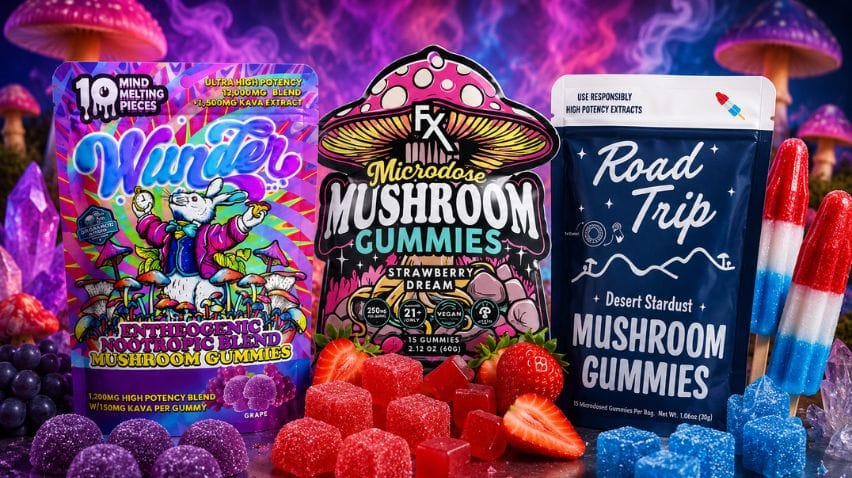
Most of the “entheogenic” or “experiential” mushroom gummies you’ll find at Shroom Time — including the Road Trip and Rize lines — are built on muscimol-based formulations, often combined with kava, kanna, GABA, and other botanical compounds.
How Do the Effects Compare?
| Feature | Psilocybin (Magic Mushrooms) | Muscimol/Amanita Gummies | Functional Mushroom Gummies |
|---|---|---|---|
| Legal status (US) | Schedule I — federally illegal | Federally legal (most states) | Fully legal everywhere |
| Receptor action | Serotonin (5-HT2A) | GABA-A | No psychoactive receptor action |
| Subjective effect | Visual, introspective, emotionally intense psychedelic | Dreamlike, dissociative, relaxing | Subtle wellness/cognitive support |
| Onset | 30–90 minutes | 30–60 minutes | Varies; often cumulative over days/weeks |
| Duration | 4–6+ hours | 2–4 hours | N/A (supplement model) |
| Drug test risk | Yes | No (with verified product) | No |
Why Some Brands Blur the Line
Here’s the part worth knowing: there’s a segment of the online market that deliberately uses psilocybin-adjacent language and imagery while selling products that either contain no active ingredient of note or are technically legal but marketed to imply they’re something they’re not.
Red flags to watch for:
- “Magic mushroom gummies” without any clarification about what’s actually in them
- No Certificate of Analysis from a named third-party lab
- Products sold with heavy implication of psilocybin effects but no disclosure of actual ingredients
- No ingredient list or dose information
At Shroom Time, every product comes with third-party lab testing (COA from SD PharmLabs), clear ingredient disclosure, and psilocybin-free verification. You know exactly what you’re taking and why.
Which Type Is Right for You?
If you want daily wellness support with no perceptible effect, functional legal mushroom gummies (lion’s mane, reishi, cordyceps blends) are your lane. Think of them as supplements.
If you want a legal, intentional experience — something you’d plan for an evening or a specific occasion — muscimol/Amanita-based gummies like Road Trip or Rize are what the entheogenic gummy market is actually offering.
If you’re looking for psilocybin, that is not what any legal online retailer in the US is selling. Any brand that implies otherwise without clear disclosure is not being honest with you.
Shop Transparently at Shroom Time
All products in the Shroom Time catalog are third-party tested, psilocybin-free, and clearly labeled. If you have questions about what’s in a product before you order, our product pages include full ingredient and COA information — and we’re always happy to help you find the right fit.
Ages 21+. Free shipping nationwide. Know what you’re taking. Shop mushroom gummies today.