









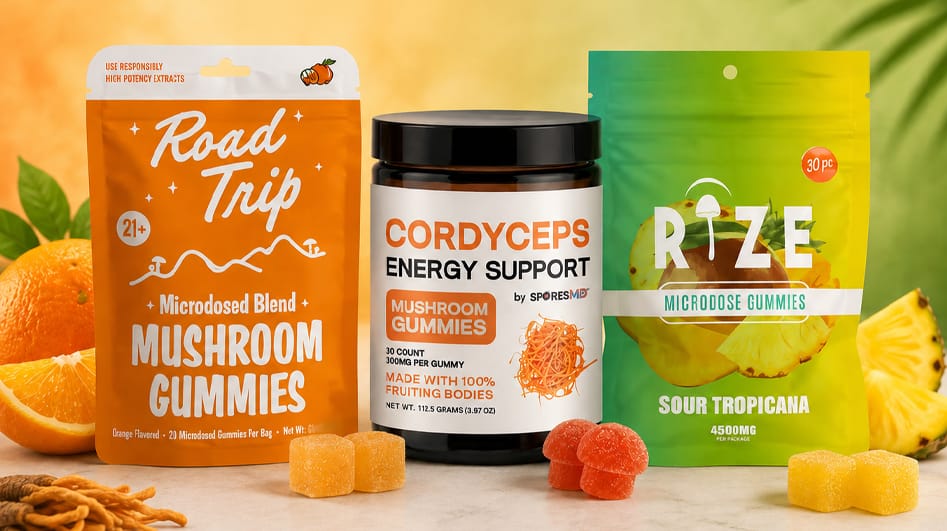
Microdosing has become one of the most searched topics in the mushroom space. People hear about it from friends, podcasts, social media, and wellness communities, then run into a basic problem: the word “microdose” can mean different things depending on the product and the person using it.
In conversations about psychedelics, microdosing usually means taking a very small amount of a psychedelic substance to avoid an intense or obvious psychedelic experience. People may be curious about microdosing for focus, mood, creativity, or a more intentional daily ritual. But the research is still developing, and reported benefits should not be treated as proven medical effects.
This guide explains what microdosing means, why people are interested in it, what current research can — and cannot — tell us, and how legal mushroom products differ from psilocybin.
Quick answer: Microdosing is the practice of taking a very small, usually sub-perceptual, amount of a psychedelic substance. People often explore it hoping for subtle changes in mood, focus, creativity, or perspective, but evidence for those outcomes remains mixed. Legal mushroom products labeled microdose are not automatically psilocybin products, so the ingredient list, serving directions, and lab information matter.
What Is Microdosing?
In psychedelic research, microdosing generally refers to taking an amount small enough that a person does not expect a full psychedelic experience. Some educational and research sources describe a microdose as roughly one-tenth to one-twentieth of a typical nonclinical dose. That description is only a rough reference — not a universal formula, medical recommendation, or standard that applies to every substance or product.
The word “sub-perceptual” is also easy to misunderstand. It does not necessarily mean that a person feels nothing. A small amount may still affect someone’s mood, body, attention, or senses. Individual responses can vary based on the substance, formulation, serving size, personal sensitivity, medications, sleep, food, and other factors.
Microdosing Is Not the Same as Taking a Full Dose
A full psychedelic dose is generally intended to create a noticeable change in perception, thought, mood, or sensory experience. Microdosing is discussed as a lower-intensity approach. The goal people describe is usually to remain able to go about their day rather than enter an immersive or overwhelming experience.
That does not make microdosing risk-free. A smaller amount can still produce an unexpected response, especially when a product is inaccurately labeled, combined with other substances, or used by someone with a relevant health condition.
Microdosing Is Not a Product Category By Itself
Microdose can describe an intended serving size or effect profile, but it’s not a single regulated ingredient category. A product marketed as a mushroom microdose may contain functional mushrooms, a non-psilocybin mushroom blend, hemp-derived ingredients, other botanicals, or a combination of ingredients. The name on the front of the package is not enough to tell you what is inside.
Psilocybin is a naturally occurring psychedelic compound found in certain mushrooms. In the United States, federal law classifies psilocybin as a Schedule I controlled substance, although state and local rules can differ. A product labeled “legal mushroom” or “mushroom gummy” should not be assumed to contain psilocybin — or to be legal everywhere.
Why Do People Microdose?
There is no single reason people become interested in microdosing. Most motivations fall into a few broad categories.
Focus and Productivity
Some people are drawn to microdosing because they are looking for a different kind of focus than the stimulation they associate with caffeine or energy drinks. They may hope for a calmer work session, fewer distractions, or a more deliberate way to approach a creative project.
Those are reported goals, not guaranteed outcomes. A product should never be marketed as a treatment for attention disorders or as a substitute for professional care.
Mood and Everyday Perspective
Others are curious about whether a low-intensity mushroom experience could support a better mood or a more flexible perspective. Online communities often describe microdosing as part of a morning routine, journaling practice, exercise plan, or broader wellness ritual.
It’s important to separate a personal report from clinical evidence. Feeling different after taking a product does not establish that the product treats depression, anxiety, or another condition.
Creativity and Curiosity
Microdosing is also associated with creative work. Artists, writers, musicians, and other curious adults may be interested in whether a small amount changes the way they notice patterns or approach a problem. For some, the interest is less about productivity and more about exploring a different mental state in a controlled setting.
Again, the experience is personal and unpredictable. Creativity is influenced by many factors, including sleep, stress, environment, practice, and expectation.
A Lower-Intensity Way to Explore Mushroom Edibles
For people who are interested in mushroom edibles but do not want to start with a high-potency format, a lower-per-serving product may feel more approachable. Gummies can offer a clearly labeled serving size, while scored chocolate bars can be divided into smaller pieces.
The key is to read the product label rather than rely on assumptions. A “microdose” product is not automatically mild for every person, and products from different brands are not interchangeable.
What Does Research Say About Mushroom Microdosing Benefits?
The short answer is that research is promising in places but not settled. People frequently search for mushroom microdosing benefits and find confident claims about mood, focus, creativity, or mental health. The evidence does not support presenting those outcomes as established facts.
The National Center for Complementary and Integrative Health (NCCIH) says it is not clear whether psilocybin microdosing is safe or effective. NCCIH also notes that people may microdose because they believe it could improve mental health symptoms, productivity, or pain — but belief and anecdotal experience are not the same as reliable clinical evidence.
Controlled research has produced mixed results. In one double-blind, placebo-controlled study of psilocybin microdosing, researchers found noticeable acute effects for some participants but no evidence that the practice improved well-being, creativity, or cognitive function overall. The study also observed a few small changes that pointed toward impaired cognition. Other reviews have emphasized that the research base is still limited, with small samples, different protocols, and challenges around expectation and placebo effects.
What the Research Does Not Prove
Current research does not prove that microdosing:
- Treats depression, anxiety, ADHD, PTSD, chronic pain, or another medical condition
- Makes someone more creative or productive in a predictable way
- Is safe for everyone when used repeatedly
- Produces the same effect across different mushrooms, extracts, gummies, chocolates, or brands
- Makes an unverified product safe simply because the package uses the word microdose
Research into psychedelics is active, and future studies may clarify which compounds, doses, and settings matter. For now, the most accurate approach is to stay curious without overstating what science has established.
Risks and Important Safety Considerations
Microdosing deserves the same careful attention as any psychoactive or mood-altering product. Small does not mean risk-free.
Possible unwanted effects associated with psilocybin can include nausea, headache, dizziness, fatigue, changes in sleep, increased heart rate or blood pressure, anxiety, paranoia, and perceptual changes. NCCIH also lists microdosing-related concerns such as insomnia, increased anxiety or depression, low energy, physical discomfort, poor focus, and changes in cognitive functioning.
People with psychotic conditions, such as schizophrenia or schizoaffective disorder, should not use psilocybin. Anyone with a serious mental or physical health condition, who is pregnant or nursing, or who takes prescription medication should speak with a qualified healthcare professional before considering a psychoactive or mood-altering product.
Avoid combining mushroom products with alcohol, cannabis, prescription medications, or other substances unless a qualified healthcare professional has specifically advised you that the combination is appropriate. Do not drive, operate equipment, or make safety-sensitive decisions after using a product that may change perception, coordination, or alertness. Keep products away from children and pets.
If a product produces severe anxiety, confusion, chest pain, trouble breathing, loss of consciousness, or another serious reaction, seek urgent medical help.
What Microdose Means at Shroom Time
At Shroom Time, microdose refers to a lower-per-serving product format designed for adults who want a lighter, more manageable mushroom edible experience. The Microdose Mushroom Gummies collection explains that its featured microdose lineup includes products from Road Trip, Rize, and CBDfx, with different flavors, serving counts, and potency levels.
Shroom Time’s microdose gummy page also states that those products are psilocybin-free and THC-free and use legal mushroom alkaloid blends. That distinction matters: these products are not the same as psilocybin mushrooms studied in psychedelic research, and the research on psilocybin cannot be used to promise the same effects from a different formula.
For chocolate fans, the Microdose Mushroom Chocolate collection focuses on scored bars that can be divided into individual squares. A scored format can make serving sizes easier to understand, but it doesn’t remove the need to follow the label or account for individual sensitivity.
If you are new to the category, compare the product page, ingredients, serving directions, and available lab information before buying. Shroom Time’s Legal Mushroom Products guide explains why the actual ingredients matter more than broad phrases like legal shrooms.
How to Shop More Carefully
A more informed approach starts before you place an order.
- Read the full ingredient list: Look for the specific mushrooms, extracts, botanicals, cannabinoids, and other active ingredients—not just the product name.
- Check the serving information: Follow the package directions and do not assume that one gummy, square, or tablet is equivalent across brands.
- Look for batch information and testing: A Certificate of Analysis (COA) can provide useful information about what a specific batch was tested for. Shroom Time’s Lab Reports page collects available reports by brand and product.
- Start with the lowest labeled serving if you choose to try a product: Give the product time to take effect according to its directions before considering anything else. Do not take more simply because you do not feel an immediate effect.
- Choose a safe setting: Do not use a new product before driving, working, traveling, caring for someone, or doing anything that requires full attention.
- Check local rules: Laws can change, and products may be restricted in some states or municipalities. The retailer’s shipping information is not a substitute for checking the rules where you live.
A transparent label will not answer every health question, but it gives you a much better starting point than vague claims or flashy packaging.
Frequently Asked Questions
Microdosing usually means taking a very small amount of a psychedelic substance to avoid a full psychedelic experience. The term is also used in the legal mushroom market to describe a lower-per-serving product format, so always check the ingredients and serving directions.
People often explore microdosing hoping for subtle changes in focus, mood, creativity, or perspective. Current research is mixed, and it does not establish microdosing as a treatment or guarantee those outcomes. Personal reports should be viewed as experiences, not medical evidence.
Psilocybin is federally classified as a Schedule I controlled substance in the United States. Some jurisdictions have created limited or different rules, so legality depends on the substance and location. Check current federal, state, and local rules before possessing or using any product.
Shroom Time’s Microdose Mushroom Gummies page states that the featured microdose gummies are psilocybin-free and THC-free. Product formulas can vary, so review the individual product page and label before purchasing or using any item.
Timing depends on the specific product, ingredients, serving size, food, metabolism, and individual sensitivity. Follow the product’s directions and avoid taking more just because the first serving has not produced an immediate effect.
The safety and effectiveness of psychedelic microdosing are not established for everyone, and some people may experience anxiety, sleep changes, impaired focus, or other unwanted effects. Anyone with a relevant health condition or taking medication should consult a qualified healthcare professional first.
Explore Microdose Mushroom Products at Shroom Time
If you are curious about a lower-per-serving mushroom edible, start with information. Review Shroom Time’s microdose gummies, microdose chocolate bars, and available lab reports to compare formats, ingredients, serving information, and testing details.